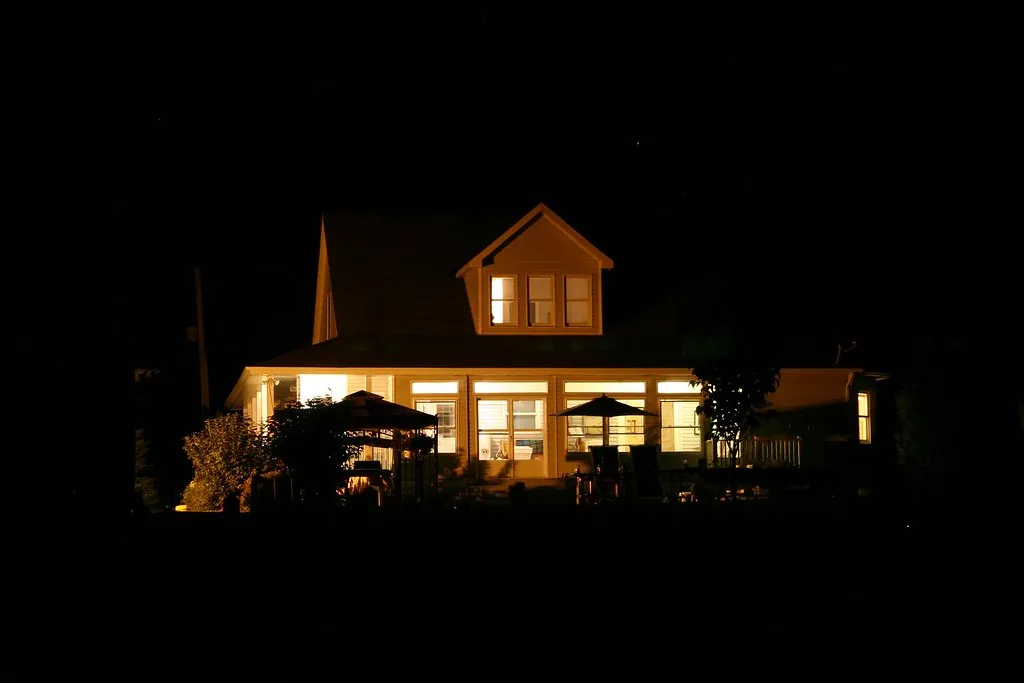
Most people think of security lighting as a big floodlight on the garage. It works, sort of, but it also blinds you, annoys the neighbors and leaves deep shadows just outside its beam. Well-designed landscape lighting for home security takes a different approach: even, layered light that removes hiding spots, guides people where you want them and helps both your eyes and your cameras see clearly.
The bonus is that a security-minded lighting plan also makes your home look beautiful at night. Here is how to design one.
Landscape lighting for home security: why layers beat floodlights
A floodlight puts a lot of light in one place. The problem is contrast. When one area is extremely bright, your eyes adjust to it, and everything outside the beam becomes darker by comparison. Someone standing just past the edge of a floodlight can be harder to see than if there were no floodlight at all.
Glare is the second problem. Looking toward a bright, unshielded source shrinks your pupils and washes out detail. Security cameras suffer the same way: a floodlight in the frame can wash out the image around it and leave faces in silhouette.
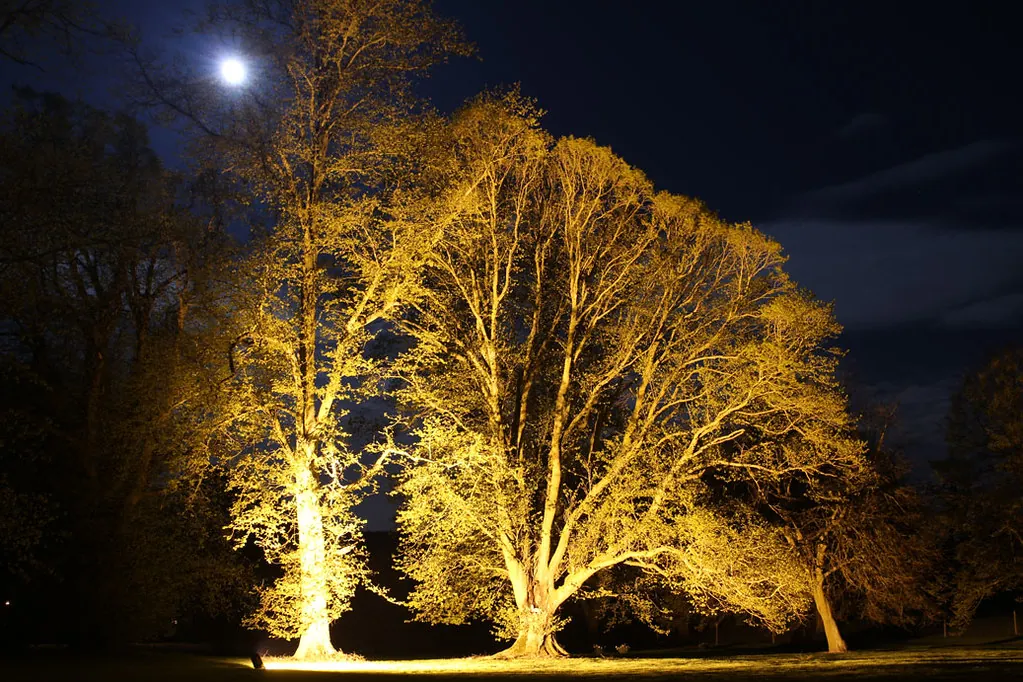
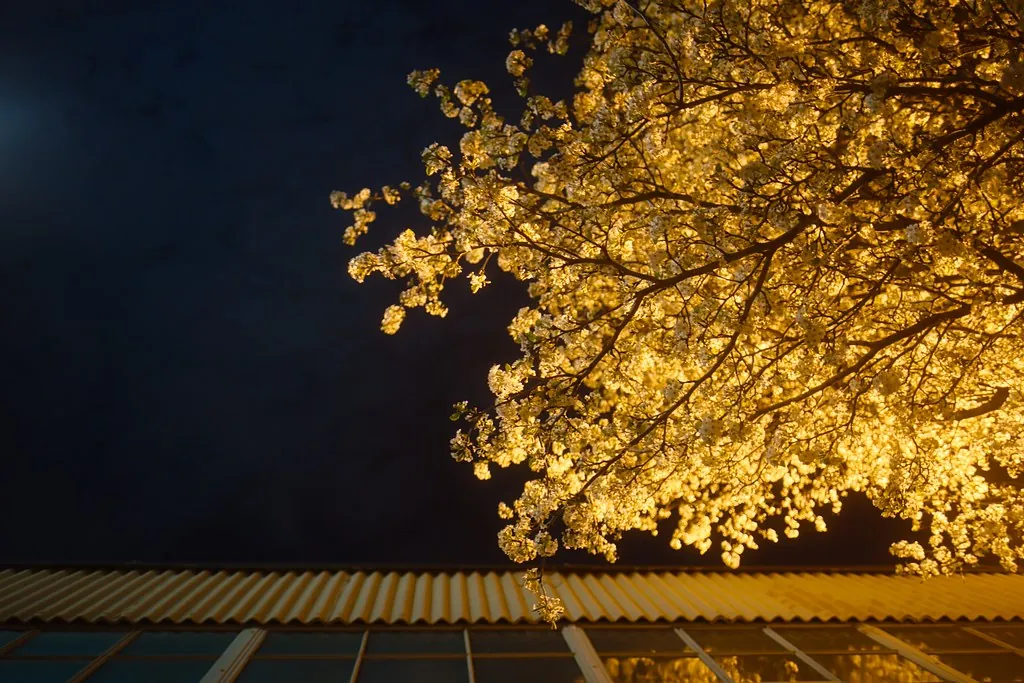
Layered landscape lighting spreads moderate light across the property using many shielded fixtures. Facades are washed with light, paths are marked, trees are uplit, and dark pockets disappear. The overall brightness is lower, but visibility is better.
Floodlight approach
- One or two very bright sources
- Harsh glare toward the street and cameras
- Deep shadows just outside the beam
- Often spills into neighbors' windows
- Makes the home look like a parking lot
Layered landscape approach
- Many low-glare, shielded fixtures
- Even light with soft transitions
- Few hiding spots near the house
- Light stays on your property
- Highlights architecture and plantings
Eliminate hiding spots first
Walk your property after dark and look at it the way an intruder would. Where could someone stand without being seen from the street or a neighbor's window? Those are the areas to light first.
- Dense shrubs and hedges beside windows and doors
- Side yards and the narrow gap between your home and the fence
- Gates, trash and AC equipment areas and the back corners of the lot
- The shadow side of large trees, especially wide live oaks
- Detached garages, sheds and pool equipment pads
- The area just beyond the reach of existing porch lights
Trimming helps as much as lighting. Keep shrubs near windows below sill height and raise the lower canopy of trees so light can reach underneath. Then use low-glare uplights, wall washers or downlights to fill what remains.
Where to put light: entries, side yards and gates
Front entry
Light the door, house numbers and steps so visitors and delivery drivers can be seen clearly. Soft facade washing on either side of the door adds depth without glare. See our architectural lighting service.
Paths and driveway
Path and driveway lights guide guests, prevent trips and make anyone walking up visible from inside. Space them evenly so there are no dark stretches. Our path light spacing guide covers the details.
Side yards and gates
These are the most overlooked areas. Wall-mounted downlights or a few well-placed uplights along the fence line remove the dark corridor that leads to your backyard.
Backyard and pool areas
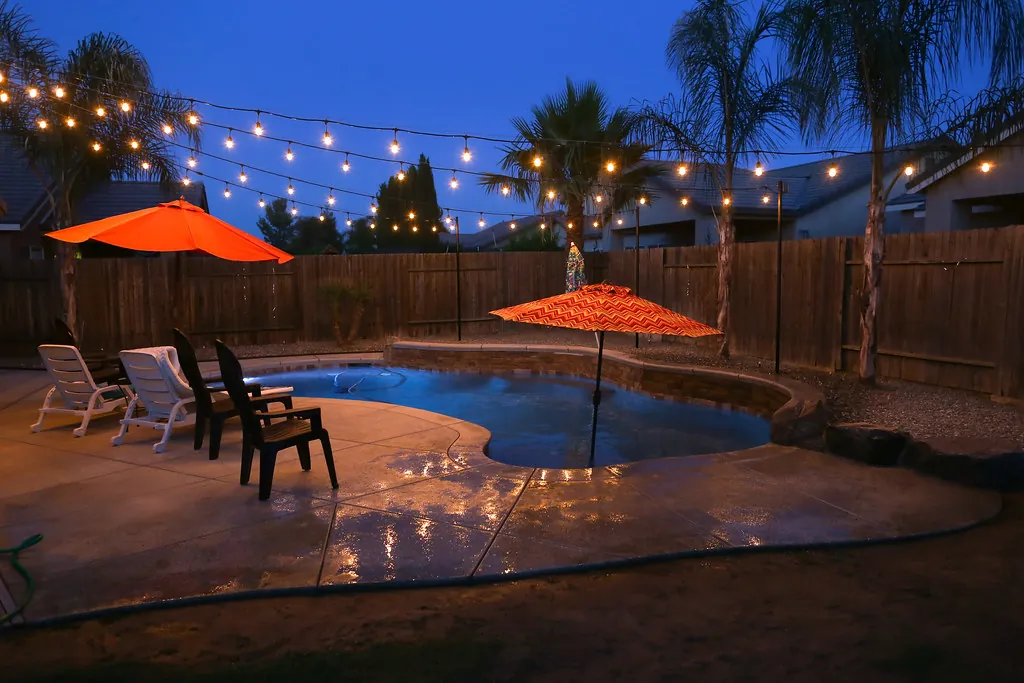
Backyards are private, which makes them attractive to anyone who wants to avoid being seen. Uplighting trees and washing the back of the house with light makes movement easy to spot from inside. Around pools and patios, lighting doubles as a safety feature for family and guests. Our patio and pool lighting designs handle both.
Trees as security lighting
Moonlighting, where fixtures are mounted high in a tree and aimed down, casts broad, natural-looking light across a lawn. It is one of the most effective ways to light a large area without glare. The tree uplighting guide explains both uplighting and moonlighting techniques.
Reduce glare so cameras and eyes see better
Glare control is the difference between lighting that helps and lighting that hurts. A few rules:
Shield every source
Use fixtures with hoods, glare guards or recessed lamps so you see the lit surface, not the bulb.
Aim away from viewers
Point lights at walls, trees and paths, never toward the street, your windows or your camera lenses.
Keep levels balanced
Moderate, even light across a scene is easier for cameras to expose correctly than one hot spot surrounded by darkness.
Check camera views at night
After installation, open your camera app after dark and adjust any fixture that creates flare or silhouettes in the frame.
Tip: Warm white light in the 2700K to 3000K range still gives plenty of visibility for people and most cameras. You do not need a harsh, cool color for security.
Motion add-ons, schedules and smart away scenes
Dusk-to-dawn scheduling
A common approach: run your full design from dusk until bedtime, then drop to a security layer that stays on until dawn. That layer might include entry lights, path lights, side yards and a couple of tree uplights. With LED fixtures, the energy cost of an all-night security layer is low. Use our sunset timer planner to map out schedules through the year.
Motion-activated boosts
Motion sensors can bring a zone to full brightness when someone walks into a side yard or driveway. This sudden change draws attention, and it is more noticeable than a light that is always on. Keep motion zones focused on approach areas so passing cars and pets do not trigger them all night.
Smart away scenes
With smart lighting controls, you can switch zones from your phone, check that lights are on while traveling and run away scenes that vary which areas are lit and when. A home whose lighting changes naturally through the evening looks lived in, even when you are hundreds of miles away.
Choosing fixtures that hold up
Security lighting only works if it is on when you need it. A dark fixture by the side gate is worse than useless, because it creates exactly the shadow you were trying to remove. That makes fixture quality and wiring part of the security conversation.
- Solid brass or copper housings resist Texas humidity, sprinklers and the occasional bump from a mower far better than thin plastic or painted aluminum.
- Sealed, waterproof connections prevent the corrosion that slowly dims fixtures and eventually kills whole runs.
- A properly sized transformer keeps voltage even, so the fixtures at the far end of the side yard are as bright as the ones by the front door.
- Tamper-resistant placement matters for key fixtures. Mount downlights high on eaves or in trees where they are hard to reach, and set path lights and uplights firmly in the ground.
It also helps to think about failure modes. If one fixture fails on a well-designed run, the rest keep working. If the transformer or timer fails, everything goes dark at once, so a smart controller that lets you check status from your phone adds a useful layer of confidence.
How much light is enough?
More is not better. The goal of landscape lighting for home security is visibility, not brightness. In most residential settings, softly lit surfaces on every side of the house do more than a few intensely bright spots. A good test: from inside, can you see someone standing in the side yard or by the back fence? From the street, can a neighbor tell whether someone is at your front door? If the answer is yes without anyone squinting, you have enough.
Balanced light also keeps you on good terms with neighbors and avoids light trespass into bedrooms next door, which matters in tightly spaced Texas subdivisions.
A layered plan, not a single fixture
Security lighting works best as part of a broader plan that includes good locks, cameras and neighbors who know your routine. Lighting removes the darkness that makes a home an easy target, and it makes the rest of your security measures work better.
We design security-minded lighting for homes across Texas, from Plano to Katy. Every project starts with a free night demo where we walk the property after dark and show you exactly where the dark spots are.