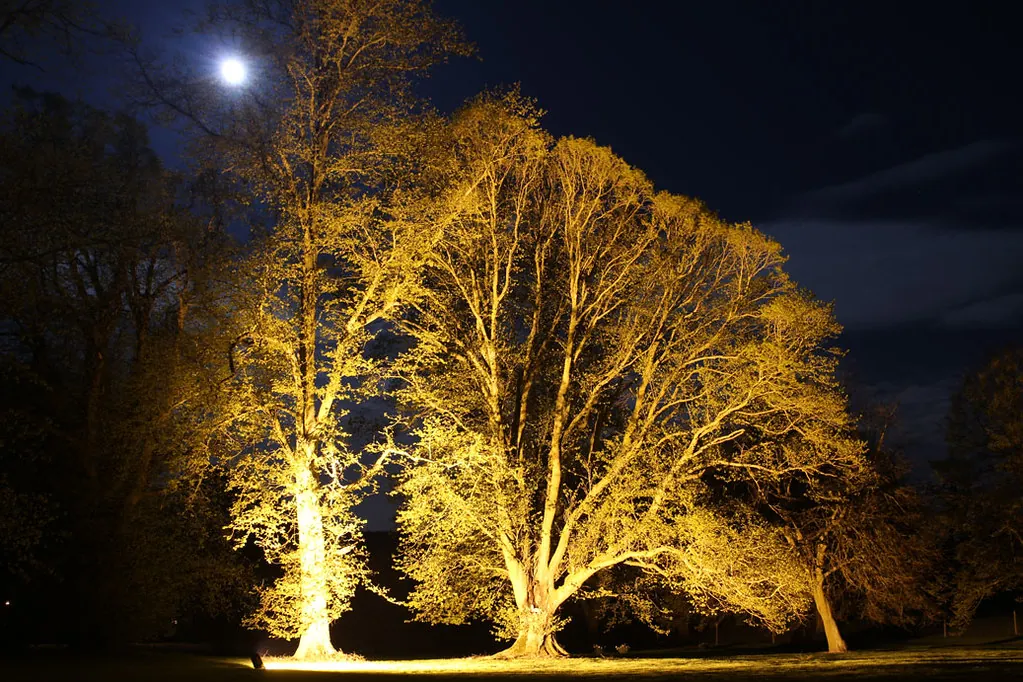
Canopy uplighting
Fixtures at the base aimed into the canopy. The classic approach for oaks, elms and pecans. Wide beams fill broad canopies; narrow beams reach tall, slender trees.
Warm LED uplighting, moonlighting and garden accents designed around the trees and native plants that grow in your part of Texas.
Trees are the biggest, most dramatic objects in most Texas yards, and they are where landscape lighting earns its keep. A well-placed uplight under a live oak turns a dark lawn into an outdoor room. A few accents in the beds give the eye somewhere to rest between the house and the street. That is the core of tree uplighting in Texas: lighting the plants that already define your property, in a way that respects how they grow.
Texas Landscape Lights designs tree and garden lighting as part of a complete 12V LED system. Every plan starts at night, in your yard, with test fixtures so you can see how a canopy responds before anything is installed.
There is no single correct way to light a tree. The right technique depends on its shape, its bark, where people will see it from and what is behind it.
Fixtures at the base aimed into the canopy. The classic approach for oaks, elms and pecans. Wide beams fill broad canopies; narrow beams reach tall, slender trees.
A fixture close to the trunk, aimed straight up, to show bark texture. Striking on crape myrtles, sycamores and the twisting trunks of older live oaks.
Downlights mounted high in the tree that cast dappled light and branch shadows across the lawn, patio or path below.
A light behind the plant aimed at a wall or fence, so the plant reads as a dark shape. Ideal for agave, yucca and sculptural natives.
Texas is too big for one plant list. What grows in a Houston yard is different from what thrives on a caliche lot outside San Antonio, and the lighting changes with it.
| Tree or plant | Where it is common | Typical approach | Planning range |
|---|---|---|---|
| Live oak | Statewide, especially Central and South Texas | 2 to 4 wide uplights around the drip line, plus moonlighting under large canopies | 4 to 8 W each, 30 to 60 degrees |
| Pecan | Central, North and Hill Country | 2 to 3 uplights for height, one aimed at the trunk | 5 to 8 W each, 25 to 40 degrees |
| Cedar elm | North and Central Texas | 1 to 2 medium uplights to show the fine branching | 3 to 6 W, 25 to 40 degrees |
| Crape myrtle | Statewide | Trunk grazing from 1 to 3 small fixtures to highlight the smooth bark | 2 to 4 W, 15 to 25 degrees |
| Palms | Gulf Coast and South Texas | 1 to 2 narrow uplights close to the trunk to reach the crown | 4 to 8 W, 10 to 25 degrees |
| Mesquite | West Texas and Hill Country | Low uplight or silhouette to show the twisting form | 2 to 5 W, 25 to 40 degrees |
| Yucca, agave, sotol | West Texas, Hill Country, xeriscapes | Grazing from below or silhouetting against a wall | 1 to 3 W, 15 to 40 degrees |
Wattage figures are typical LED planning ranges for residential work. A 60-foot pecan on an open lot needs more than a crape myrtle beside a lit porch. Our tree uplighting guide goes deeper on beam angles, fixture count and placement.
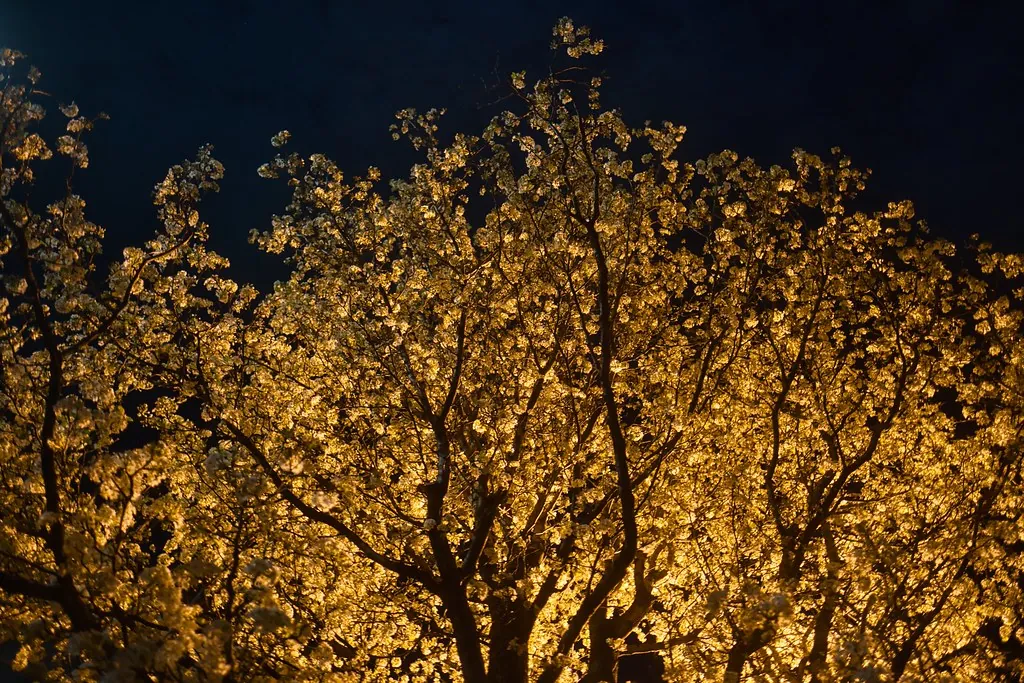
Large live oaks are perfect for moonlighting. We mount one or more downlights 20 to 35 feet up, aimed through the branches, so light falls on the ground as a soft, shifting pattern. It is one of the most natural-looking effects in landscape lighting, and it lights patios and lawns without any fixtures at eye level.
Mounts use stainless hardware and loose straps or stand-off brackets that do not girdle the limb. Wire runs down the trunk in a tight, bark-colored channel so it disappears in daylight.
Beds are where layered lighting comes together. A few small accent lights, often 1 to 3 watts each, pick out ornamental grasses, a specimen Japanese maple in a shaded corner, a boulder or a birdbath. In Hill Country and West Texas xeriscapes, grazing an agave or sotol from a low angle creates bold shadows on gravel and stone. We keep bed fixtures low and tucked behind foliage so they are hidden by day.
Seasons change the picture. Crape myrtles bloom in summer, then drop their leaves and show sculptural bark all winter, so one set of grazing lights gives you two looks a year. Live oaks stay green, which makes them reliable anchors for year-round tree uplighting in Texas. Pecans and cedar elms look completely different bare, when the light traces every branch against the winter sky.
Blackland clay in Dallas, Fort Worth and Austin swells after rain and cracks in drought. Fixtures on short stakes lean, and lenses end up pointed at the neighbor's window. We set uplights on longer stakes, check plumb at the final adjustment visit and leave slack in the cable so soil movement does not pull connections apart.
Old oaks have dense surface roots, so we never trench across the root zone. Instead we route wire around major roots or pull it shallow under mulch where the code and the site allow. In the Hill Country, limestone and caliche often sit just below the surface, and careful routing along bed edges beats breaking rock.
A freeze like February 2021 kills tender plants and can leave a lighting design pointed at an empty bed. Hard freezes and ice can also bring down limbs that carry moonlight fixtures. After major weather we recommend a quick check of aim and mounts, which our repair team can handle.
Watch out: Cheap uplights with exposed lamps and no shielding can throw a hot spot straight into your eyes from the patio. Always check a tree light from where you will actually sit or walk, not just from the street.
Most of the trees we light look best at 2700K, which keeps leaves a natural, deep green and warms bark. Some designers use 3000K on blue-gray foliage like cenizo, Arizona cypress or silver palms. We test both during the demo. If you are curious, the color temperature guide shows how each option reads on different materials.
Tree lighting pairs naturally with architectural lighting on the house and with a smart timer that dims the canopy later in the evening. We light trees and gardens for homes in Austin, San Antonio, New Braunfels and across the state.
Have a tree you have always wanted to see lit at night? Book a free consultation and we will bring fixtures out after dark to show you how it looks.
A mature live oak with a wide canopy usually needs two to four uplights placed around the trunk so the canopy reads from more than one angle. Smaller trees often need just one or two.
Low-voltage cable is shallow and small, and we route it around major roots rather than cutting through them. We avoid trenching close to the trunk of oaks and other sensitive trees.
Moonlighting places a downlight high in a tree so light filters through the branches onto the ground below, creating soft, dappled shadows that look like moonlight.
Yes, occasionally. Trees thicken and canopies spread, so we recommend checking aim and output every year or two, and moonlight fixtures may need their mounts loosened as limbs grow.
Yes. Palms respond well to uplighting from one or two fixtures at the base. Near the Gulf we use brass or copper fixtures with sealed lenses to handle salt air and humidity.
Share a few details and we will reach out to schedule a free consultation. We will talk through your goals, look at the property and, where it helps, show you a night demo before you decide anything.
Talk to Texas Landscape Lights about a custom lighting plan for your property, anywhere in Texas.