Path lights
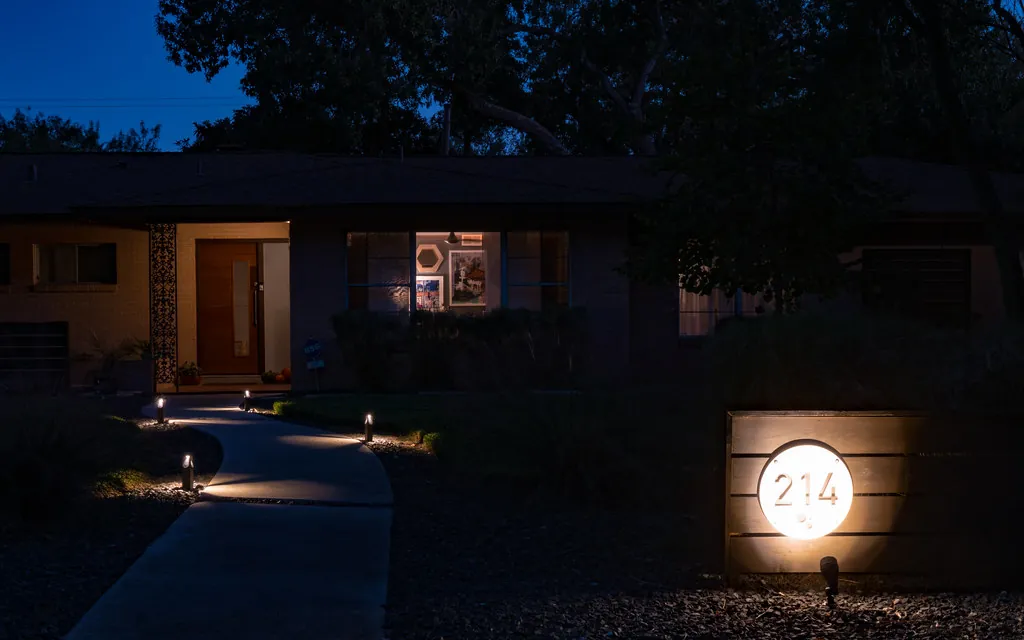
A hat-style or area fixture on a short stem that throws a downward circle of light, usually 6 to 10 feet across. Best for front walks, garden paths and side yards.
Low-glare path lights, driveway markers and step lights that make arriving home safe and easy, spaced and aimed so your yard never looks like an airport runway.
Pathway lighting in Texas has a practical job before it has a decorative one. It shows you where the walk is, where the step changes height and where the driveway meets the lawn. Done well, it does that quietly, with pools of warm light on the ground and very little light in your eyes. Done poorly, it becomes a row of bright dots that blinds guests and makes the rest of the yard look darker.
Texas Landscape Lights designs path, driveway and step lighting as part of a whole 12V LED system, so arrival lighting works with your facade lighting and trees instead of competing with them.
Most homes need some combination of path lights, driveway markers and step lights. Each one solves a different problem.
A hat-style or area fixture on a short stem that throws a downward circle of light, usually 6 to 10 feet across. Best for front walks, garden paths and side yards.
Low bollards, small path lights or in-grade markers that define edges and curves. The goal is guidance for drivers, not full illumination of the concrete.
Compact fixtures mounted in a riser, a side wall or under a tread nosing. They light the tread so every change in height is obvious.
The most common mistake we see is fixtures placed in a straight, evenly spaced line on both sides of a walk. It looks like a runway, and it uses twice as many lights as necessary. A better layout staggers fixtures from side to side so their light pools overlap slightly in the middle of the path. You get continuous coverage without a regimented look.
Spacing depends on how wide each fixture spreads its light. A path light with a 6-foot spread at ground level might sit 8 feet from the next one. A wider area light can stretch to 12 feet or more. Our path light spacing guide covers the math in detail, and the fixture estimator gives a quick count for your walk length.
Glare comes from seeing the light source directly. Path lights with a deep hat or a fully shielded top send light down where you need it. Step lights with louvered or hooded faceplates do the same on stairs. We avoid bare, exposed-lamp fixtures entirely on walks, because the eye adjusts to the brightest thing it sees and everything else falls into shadow.
For a residential path, 50 to 150 lumens per fixture is usually plenty. That is far less than people expect. Steps and grade changes can use a bit more, and driveway markers can use less because headlights do most of the work. Lower output also keeps your pathway lighting friendly to dark skies and neighbors.
Driveways get special attention because they are large, flat and visible from the street. We usually mark the entrance on both sides so it is easy to find, then follow one edge or highlight only the curves and the transition into a motor court. On long rural or Hill Country drives, a few markers at turns and gates often do more than a continuous line.
In-grade markers set flush with the concrete can be driven over, but they need a drained gravel base and a sealed, heavy-duty housing. Where flash flooding is a concern, we favor above-grade markers set back from the edge.
Path lights live closer to sprinklers, mowers, dogs and foot traffic than any other fixture in the yard. Material choice matters.
| Material | Strengths | Watch for |
|---|---|---|
| Solid brass | Very durable, will not rust, develops a natural patina | Higher upfront cost |
| Copper | Ages to a warm bronze or verdigris, handles humidity well | Patina color shifts over time |
| Powder-coated aluminum | Lighter, wide color choices, lower cost | Coating can chip, then corrode near salt air and sprinklers |
| Composite or plastic | Inexpensive | Becomes brittle under Texas UV, breaks when bumped |
For Gulf Coast homes in places like Katy and Sugar Land, brass and copper are the safest bets against humidity and salt. In North Texas, a sturdy stem matters as much as the finish, because hail and windblown debris can bend thin fixtures. Every fixture we install gets a stake long enough to stay plumb in shifting clay soil.
During the free night demo we set temporary fixtures along your path and drive to adjust spacing and brightness while you watch.
Fixtures sit 12 to 18 inches into beds where possible, out of the path of mowers and string trimmers, and are angled to light the walk.
Low-voltage cable is buried deep enough to clear edgers and aeration plugs, and runs along bed lines so future digging is less likely to hit it.
We use waterproof, gel-filled connectors, which matter in clay that stays wet after rain and in irrigated beds.
At the final adjustment visit we level each fixture, check voltage at the far end of each run and set the timer.
Tip: Step lights are worth adding even if you only light a few stairs. Falls happen at grade changes, and a single riser light at the top and bottom of a short run of steps makes a real difference for older family members and guests.
Well-lit paths reduce trips and falls, help delivery drivers find the door and remove the dark corners that make a home feel vulnerable. Combined with lighting on the facade and side yards, good pathway lighting is a core part of landscape lighting for home security. Because LED path lights use only a few watts each, running them dusk to dawn costs very little.
Side yards and gates deserve attention too. A single path light at a side gate, or a small step light near trash bins and AC units, makes nighttime chores safer and removes a common hiding spot. These short runs usually tie into the same transformer as your front walk. That kind of practical, low-glare pathway lighting is what most Texas homes actually need.
We install pathway and driveway lighting for homes in Plano, Houston, Austin, San Antonio and across Texas. If your current path lights are dim, tilted or half dead, our repair service can often bring them back or retrofit them to LED.
Ready to see your walk and drive lit properly? Book a free consultation and we will lay it out with you after dark.
Most residential paths look best with fixtures 8 to 12 feet apart, staggered from side to side. Exact spacing depends on fixture height, light spread and how much ambient light reaches the walk.
Usually not. Marking one side, or both sides only at the entrance and any curves, guides drivers without creating a runway look. Wider drives or blind turns sometimes justify both sides.
They can if they sit right at the turf line. We set fixtures back into the bed 12 to 18 inches where possible and bury wire deep enough to clear edgers and aeration tines.
Yes. Many step lights mount on the face of a riser or the side of a wall cap, and some can be surface-mounted where coring into stone is not practical. We assess each step during the consultation.
Solar lights are inexpensive but tend to be dim, short-lived and inconsistent, especially under trees or after cloudy days. A 12V low-voltage system gives steady, adjustable light on a schedule for many years.
Share a few details and we will reach out to schedule a free consultation. We will talk through your goals, look at the property and, where it helps, show you a night demo before you decide anything.
Talk to Texas Landscape Lights about a custom lighting plan for your property, anywhere in Texas.