Ask ten installers about the best landscape lighting for Texas and you will hear a lot about brands. The truth is simpler: what lasts here is a set of specs. Fixture material, how the LED handles heat, the quality of the seals, the wire and the connectors decide whether a system still looks sharp in year eight or starts flickering after two summers. This guide breaks down each piece so you can judge any product or proposal on its merits.
Texas is hard on outdoor electronics in several ways at once. Surface temperatures on mulch and rock can climb well past the air temperature in July. Intense UV fades plastics and paint. Sprinklers and heavy rain soak fixtures, then the sun bakes them. Coastal homes add salt air, and North Texas adds hail. A good system plans for all of it.
What makes the best landscape lighting for Texas
- A fixture body that will not rust, crack or fade.
- An LED that stays cool enough to keep its brightness and color.
- Gaskets and lenses that keep water and bugs out year after year.
- Wire sized so every fixture gets the right voltage.
- Waterproof connections that do not corrode underground.
Fixture materials compared
The fixture body is your first line of defense. Here is how the common options behave in Texas conditions.
| Material | Heat and UV | Corrosion and salt air | Hail and impact | Best fit |
|---|---|---|---|---|
| Solid brass | Excellent, no finish to fade | Excellent, develops patina | Very good | Most homes, coastal properties, long-term installs |
| Copper | Excellent, weathers to brown or green | Very good | Good, softer metal can dent | Traditional and natural landscapes |
| Powder-coated aluminum | Good when the coating is thick | Fair, chips can corrode, poor near the coast | Fair | Budget projects inland |
| Composite or engineered resin | Good if UV-stabilized | Excellent, nothing to rust | Good | Coastal and pool areas, high-moisture beds |
| Thin stamped metal or plastic kits | Poor, fades and warps | Poor | Poor | Short-term only |
Brass is our default recommendation for most Texas homes because it has no paint to peel and simply darkens to a soft bronze tone that blends into beds. Aluminum can be a smart way to stretch a budget in Dallas or San Antonio, but near Galveston Bay or the coast, salt finds every chip in the powder coat.
Integrated LED vs MR16 and drop-in lamps
Modern landscape lighting is LED, but there are two common ways to package it.
Integrated LED
The LED board is built into the fixture and sealed at the factory. Good integrated fixtures pair the LED with a heat sink designed for that body, which helps in high heat. Some offer adjustable output. The tradeoff: when the LED eventually dims or fails, you typically replace the whole fixture or its light engine.
MR16 or drop-in lamps
A replaceable LED lamp sits inside a durable fixture body. You can swap beam angle, brightness or color temperature later as trees grow or tastes change. Quality matters: choose lamps rated for enclosed fixtures and outdoor use, since cheap lamps run hot inside a sealed housing.
Either approach can be the best landscape lighting for a Texas yard if the components are good. We often like a solid brass body with a high-quality replaceable lamp, because a brass fixture can outlast several generations of LED technology.
Heat, UV and LED lifespan
LEDs do not burn out like halogen bulbs. They slowly lose output, and heat speeds that up. In practical terms, a fixture sitting in full afternoon sun on dark mulch or stone needs good thermal design. Look for:
- Metal heat sinks or bodies that pull heat away from the LED.
- Lamps rated for enclosed and outdoor fixtures, not indoor spot lamps.
- Glass lenses rather than plastic, which can yellow and haze under UV.
- Stable color over time, so the house does not shift from warm white to greenish.
- Drivers and lamps that tolerate the voltage range found on long wire runs.
IP ratings, gaskets and seals
An IP (ingress protection) rating tells you how well a fixture keeps out dust and water. The first digit is solids, the second is liquids. For Texas landscapes, a practical guide is:
- IP65: protected against water jets. A sensible minimum for above-ground uplights, path lights and wall lights.
- IP67: protected against temporary immersion. Use for in-grade well lights and fixtures in low spots that flood during storms.
- IP68: continuous immersion. Required for pond, fountain and underwater lights.
The rating is only as good as the gasket. Silicone gaskets hold their shape in heat far better than cheap rubber, which hardens and cracks. Every time a lamp is changed or a lens is cleaned, the gasket must seat properly again. Condensation inside the lens is the classic sign a seal has failed.
Gulf Coast salt air and humidity
In Houston, Sugar Land, Katy and especially closer to the coast, moisture and salt work on every exposed metal surface. Brass, copper and composite bodies, stainless hardware and sealed connections make a big difference. Rinsing fixtures near the coast a few times a year helps too. Our Houston landscape lighting team plans around these conditions on every job.
Hail and storms
North Texas hail can crack plastic lenses and dent soft fixtures. Low-profile fixtures, solid metal bodies, recessed glass and shrouds that shield the lens all help. Placing uplights within plantings rather than in open lawn adds protection. Homeowners in our Dallas and Fort Worth service areas often choose brass bodies with recessed glass for exactly this reason. For more on prepping for severe weather, see protecting landscape lighting from Texas storms.
Direct-burial wire and voltage drop
Wire is where many systems quietly fail. Use only wire rated for direct burial, sized for the load and distance. Common residential choices are 12 gauge for typical runs and 10 or 8 gauge for long or heavily loaded runs. Undersized wire causes voltage drop, which shows up as dim, uneven fixtures at the end of the line. Pairing the right wire with a properly sized multi-tap transformer keeps voltage consistent. Our transformer sizing calculator helps you see the total load.
In the expansive clay soils of Dallas and Fort Worth, leave slack in the wire so ground movement does not pull connections apart. In rocky Hill Country soils, protect wire from sharp limestone edges.
Waterproof connectors
Most landscape lighting repairs we see trace back to a bad connection. Push-pin and piercing connectors that come with kits let moisture in, then corrode. Professional installs use connections designed to be sealed, such as gel-filled or heat-shrink style waterproof connectors, often combined at a common hub. It is a small cost that prevents a lot of digging later.
Warning: If your current lights flicker after rain, or one section goes dark, a failing underground connection is the usual suspect. Our landscape lighting repair service can trace and fix it.
Solar vs low voltage in Texas
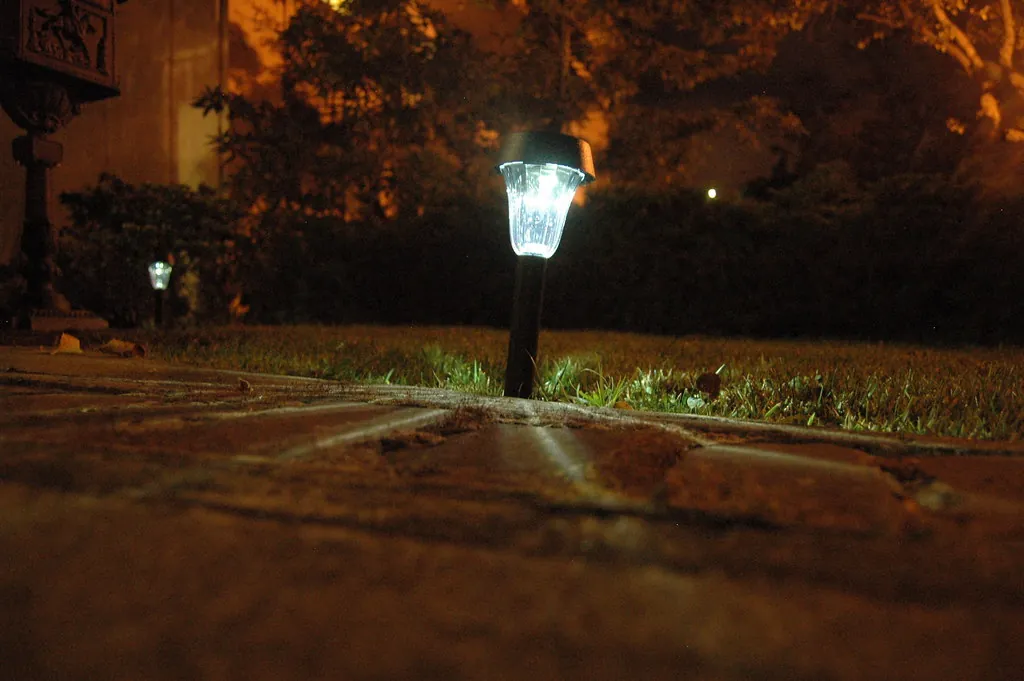
Solar stake lights are cheap and easy, and they have a place for small decorative accents. But they struggle as a primary lighting system. Output is low and fades through the night, cloudy stretches leave them weak, and the batteries degrade quickly in Texas heat. A 12V low-voltage LED system delivers consistent, controllable light, can be dimmed and scheduled, and costs very little to run. For anything beyond a few accents, low voltage is the clear choice.
Tip: Do not overlook color. The best fixture in the world still looks wrong if the color temperature clashes with your brick or stone. Read our guide to warm white vs cool white landscape lighting.
A spec checklist for comparing proposals
When two bids look similar on paper, these questions reveal which system is built for Texas:
Ask what the fixtures are made of
Solid brass, copper or a UV-stabilized composite should be named by material, not just "metal." If the answer is aluminum, ask about coating thickness and how close you are to the coast.
Ask about the lamps
Find out whether the LEDs are integrated or replaceable, what color temperature and beam angle each fixture uses, and whether the lamps are rated for enclosed outdoor fixtures.
Ask about seals and ratings
Confirm IP ratings for each fixture type, especially well lights in low areas and anything near a pool or pond.
Ask about wire and connections
Request the wire gauge for each run, the transformer size and spare capacity, and the type of waterproof connector used underground.
Ask about controls and adjustments
A timer, photocell or smart controller should be included, along with a final visit after dark to aim and balance the fixtures.
For budget context on these choices, see how much landscape lighting costs in Texas, or browse our full list of lighting services.
Putting it together
The best landscape lighting for Texas is not one product. It is durable bodies, well-cooled LEDs, real seals, properly sized wire and sealed connections, designed for your region and installed with care. If you would like a plan built around those specs for your home, we will show you the options at a free night demo.