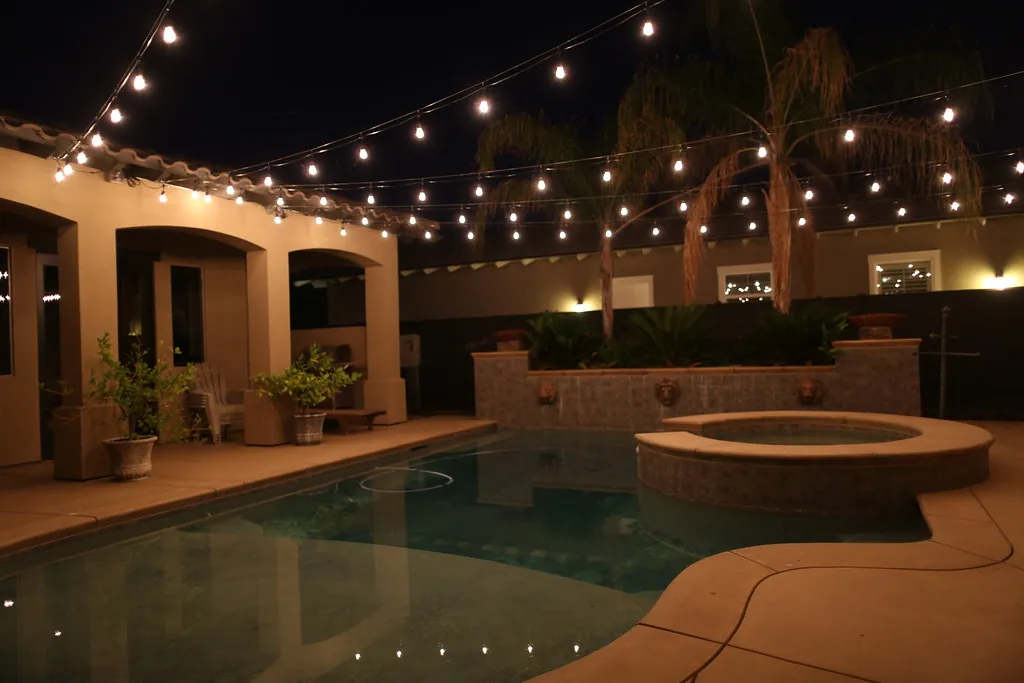
If you are asking how much does landscape lighting cost in Texas, the honest answer is that it depends on how many fixtures your property needs and what those fixtures are made of. The good news is that professional low-voltage LED systems follow predictable patterns, so you can build a realistic budget before anyone walks your yard. This guide gives you the planning ranges we use when we talk with homeowners, the factors that push a project higher or lower, and what the system costs to run once it is in.
One note before the numbers: everything below is a typical planning range, not a quote. Your actual price comes from a site visit, a design and a written proposal.
The short answer: cost per fixture installed
The simplest way to budget is to think in cost per fixture installed. That figure rolls together the fixture, the LED lamp, direct-burial wire, waterproof connectors, labor, and a share of the transformer, timer or smart controls. For professional low-voltage LED installs in Texas, a typical planning range runs roughly $250 to $500+ per fixture installed.
- Lower end ($250 to $325): quality powder-coated aluminum or composite fixtures, simple layouts, easy soil, short wire runs.
- Middle ($325 to $425): solid brass or copper fixtures, a mix of uplights and path lights, moderate trenching, a timer or photocell.
- Upper end ($425 to $500+): premium brass, integrated LED with adjustable output, tree-mounted downlights, hardscape lights cut into stone, smart app control, difficult soil or long runs.
Want a rough count for your own property? Our fixture estimator walks through your facade, trees and paths and suggests a fixture count you can multiply against these ranges.
How much does landscape lighting cost in Texas for a whole project?
Fixture counts cluster into a few common project sizes. A modest front yard might light the facade, an entry path and one tree. A full property adds the backyard, patio, pool and specimen trees. Here is how that usually translates into budget.
| Project size | Typical fixtures | What it usually covers | Planning range |
|---|---|---|---|
| Small | 8 to 12 | Front facade, entry walk, one feature tree | $2,500 to $6,000 |
| Medium | 15 to 25 | Front and back, patio, several trees, path or driveway | $5,000 to $12,000 |
| Large | 25 to 40 | Whole property, outdoor living, pool, mature canopy trees | $9,000 to $20,000 |
| Estate | 40 to 75+ | Acreage, long driveway, multiple zones, smart controls | $15,000 to $35,000+ |
Tip: These ranges assume a professional design with quality fixtures and LED lamps. Big-box kits cost less up front but often fail within a few Texas summers, which makes the real cost higher once you count replacements.
What drives landscape lighting cost
Two homes with the same fixture count can land at very different prices. These are the factors that matter most.
Fixture material
Solid brass and copper cost more than aluminum but shrug off heat, sprinklers and Gulf Coast salt air. They also develop a natural patina instead of peeling paint.
Transformer
A stainless steel, multi-tap transformer sized for your total wattage with headroom costs more than a basic unit, but it keeps voltage even across long runs and leaves room to grow.
Wire runs
Long distances to the back fence or down a driveway need heavier gauge wire, sometimes multiple home runs, to avoid voltage drop and dim fixtures at the far end.
Trenching and soil
Sandy loam trenches quickly. Blackland clay, caliche and Hill Country limestone take more labor, and crossing concrete may require boring or sleeving.
Controls
A simple photocell or astronomical timer is inexpensive. Smart controls with zones, dimming and app scheduling add cost but give you far more flexibility.
Design time
A good lighting plan, a night demo and a final after-dark adjustment visit take real hours. That design work is what separates a dramatic result from a runway of lights.
Specialty fixtures that change the math
Some lights take more labor than a standard stake-mounted uplight. Tree-mounted downlights for moonlighting require a climb, careful mounting hardware and wire run up the trunk. Step and wall lights set into stone or concrete require cutting and patching. Underwater or fountain lights need specific fixtures and placement. Expect these to sit at the high end of the per-fixture range or above it.
Electrical access
Your transformer plugs into an exterior GFCI outlet. If there is no suitable outlet near where the transformer should go, a licensed electrician will add one. That line-voltage work is a separate line item from the low-voltage lighting system.
Texas regional notes
Texas is big enough that cost drivers shift by region:
- Houston and the Gulf Coast: soil is generally easy to trench, but humidity, heavy rain and salt air near the coast make sealed fixtures, brass or copper, and quality connectors worth the extra money. See our Houston landscape lighting page for local details.
- Dallas, Fort Worth and North Texas: expansive blackland clay shifts with wet and dry cycles, so wire needs slack and good burial depth. Hail is a real consideration for exposed fixtures.
- Austin, San Antonio and the Hill Country: shallow soil over limestone and caliche can slow trenching. Designers often route wire through planting beds and under mulch to limit rock work. Our Austin service area page covers more.
- Larger lots and acreage: long driveways and distant trees add wire, trenching time and possibly a second transformer.
What it costs to run each year
Operating cost is the pleasant surprise. LED landscape lamps typically draw about 2 to 8 watts each, a fraction of the 20 to 50 watt halogen lamps used in older systems. Using a round planning figure of about 15 cents per kWh for Texas residential electricity, here is a simple example.
Add up the wattage
20 fixtures at about 4 watts each equals 80 watts. Add roughly 10 percent for transformer losses and you are near 90 watts.
Multiply by hours
At 8 hours a night for 365 nights, that is 2,920 hours. 90 watts times 2,920 hours equals about 263 kWh per year.
Apply the rate
263 kWh times $0.15 is roughly $39 per year, or a little over $3 a month.
Plug your own numbers into the energy cost calculator, or read how much electricity landscape lighting uses for a deeper breakdown. Running lights dusk to midnight instead of dusk to dawn cuts the number further.
What a professional price should include
When you compare proposals, make sure each one covers the same scope. A complete professional install generally includes:
- A lighting design based on how you use the property, ideally confirmed with a night demo.
- Fixtures and LED lamps specified by model, material and color temperature.
- A transformer sized to the total load with room to expand, plus a timer, photocell or smart controller.
- Direct-burial wire of the right gauge for each run, with sealed, waterproof connections.
- Trenching, wire burial and cleanup of beds and lawn.
- A final adjustment visit after dark to fine-tune aim and brightness.
If one bid is far lower than the others, the difference is usually hiding in one of those lines. Ask what is left out.
Ways to get more for your budget
- Light what matters most first: the facade, the entry and one or two signature trees.
- Choose fewer, better fixtures rather than many cheap ones. Good optics do more with less.
- Ask for a transformer with spare capacity so a backyard phase is simple later.
- Route wire through existing beds to avoid trenching through rock or lawn where possible.
- Pick a timer or photocell now; you can upgrade to smart controls later.
- Get the design right with a night demo before you commit to a fixture count.
Watch out: A very low bid usually means thin aluminum fixtures, undersized wire or crimp connectors that corrode. In Texas heat and humidity, those shortcuts tend to show up as flickering, dead zones and repair calls within a few years.
Getting a real number for your property
Planning ranges help you decide whether a project fits, but every yard is different. A short consultation and night demo lets you see the effect before you spend anything, and the written proposal spells out fixture counts, materials and controls so you can compare apples to apples. Browse our landscape lighting services to see what a full design can include.
When you are ready, we will walk your property, show you the lighting after dark and put a clear plan and price in writing.