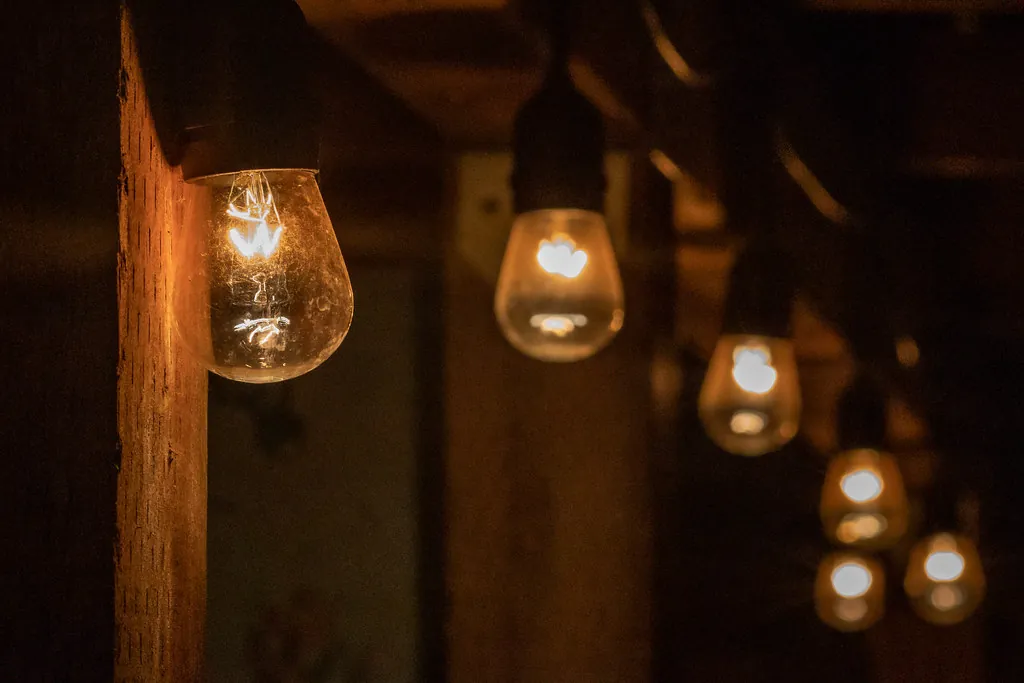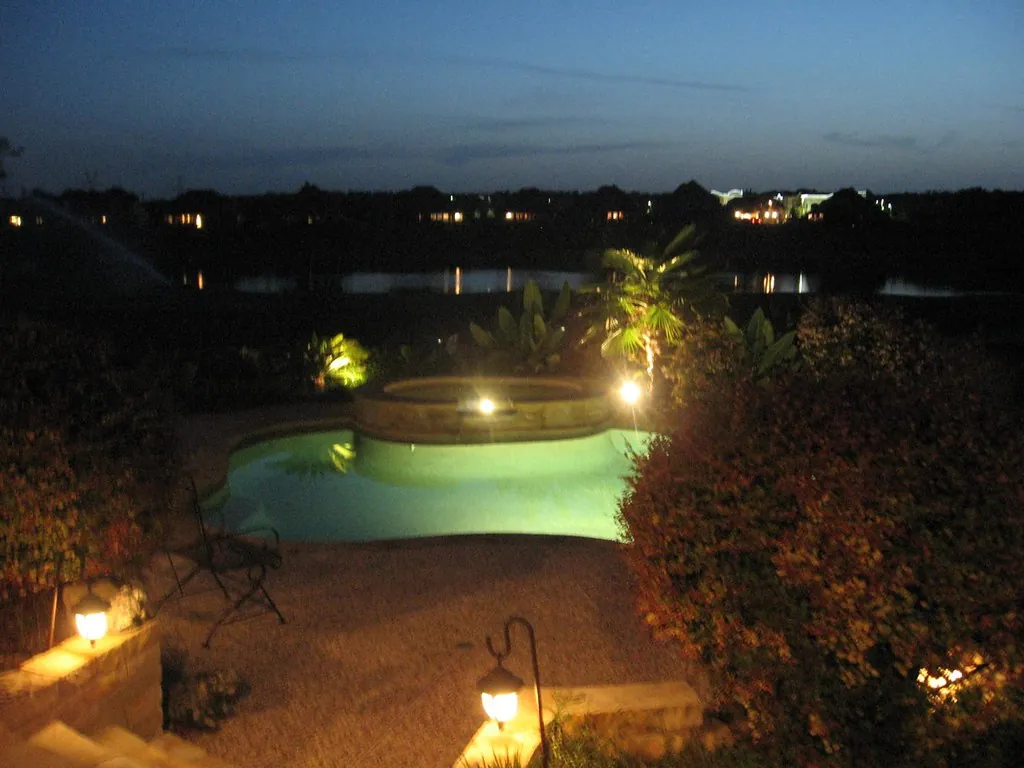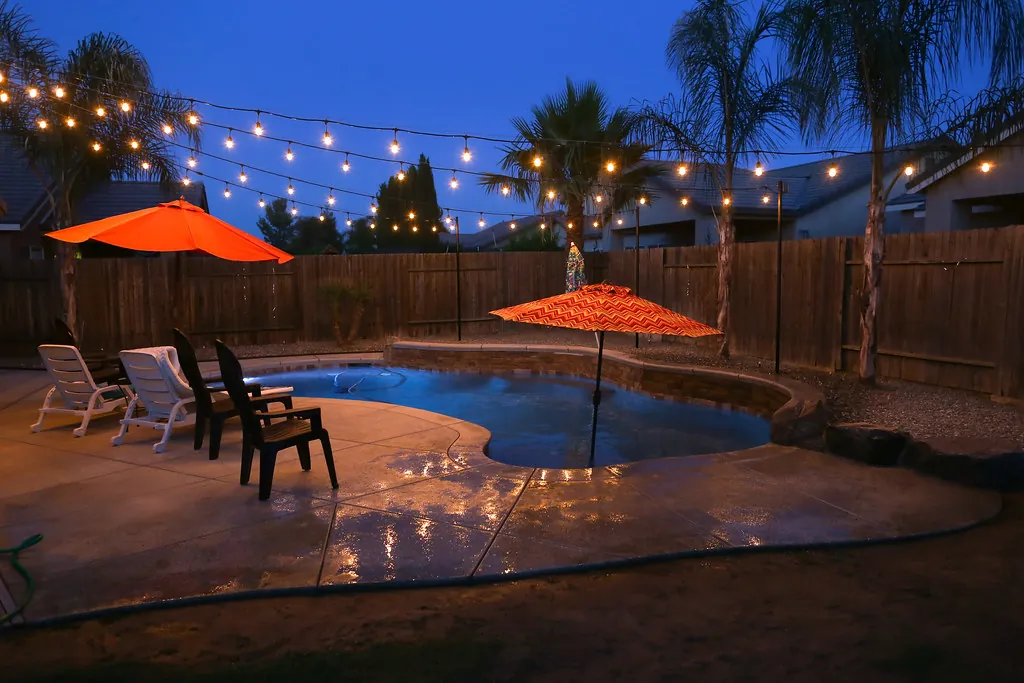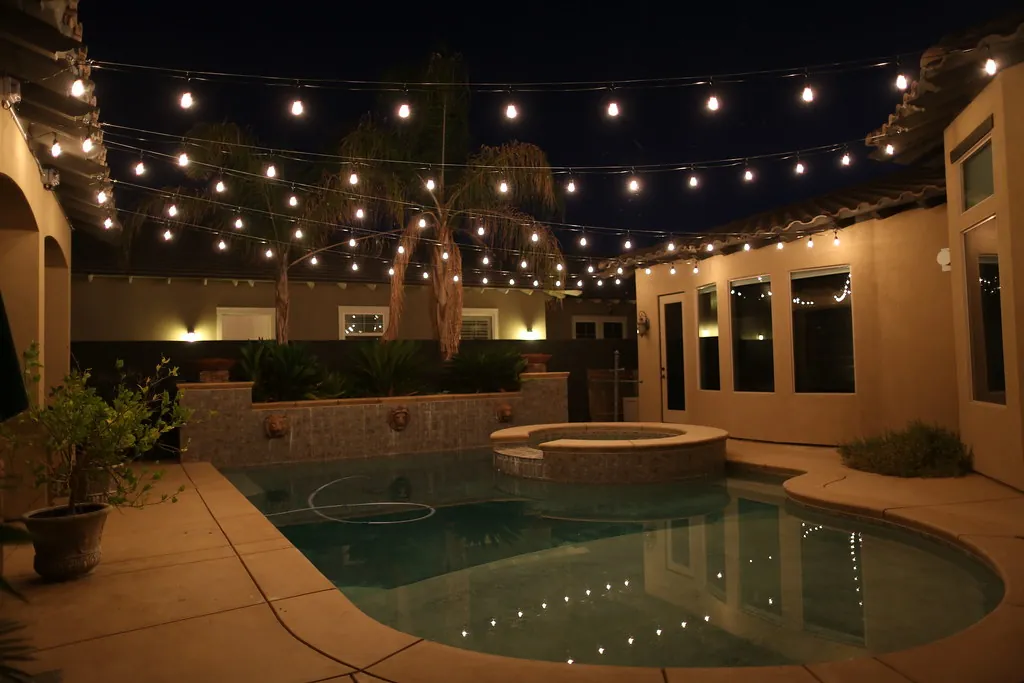
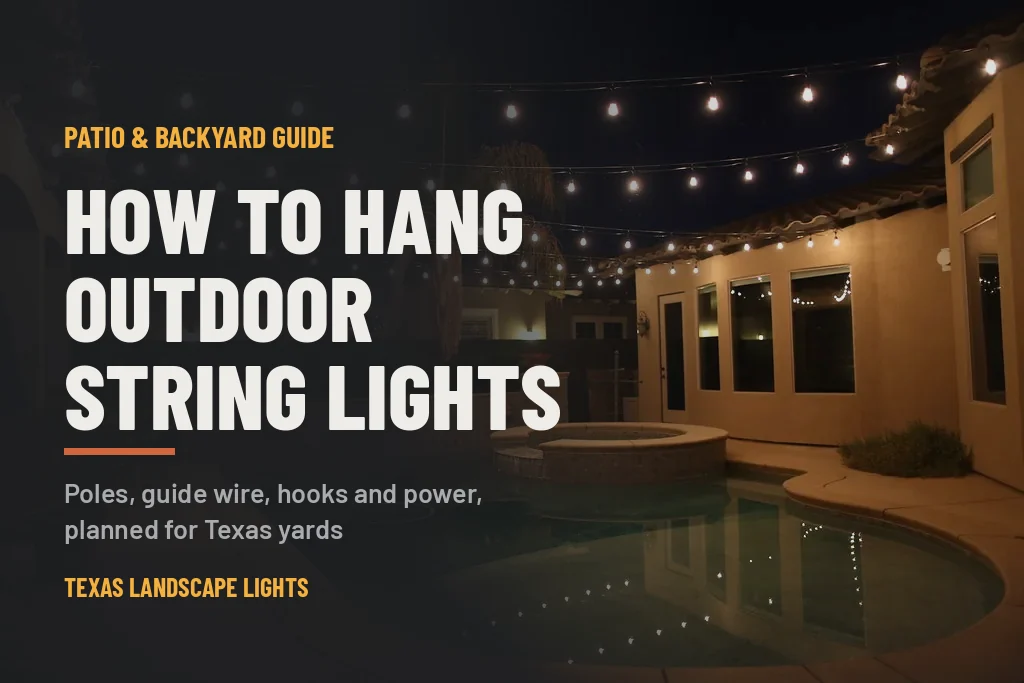
The quick answer to how to hang outdoor string lights: map your layout first, anchor every run to something solid (the house, a fence post, a tree or a dedicated pole), carry the weight on a tensioned guide wire for any span longer than about 15 feet, and plug into a GFCI-protected outdoor outlet on a timer. Get those four things right and your lights will hang straight, survive Texas wind and look like they belong there.
String lights are one of the easiest ways to make a patio, pool deck or backyard feel finished after dark. They are also one of the easiest things to do badly. Sagging strands, hooks pulling out of soffits and cords snaking across the deck are all common. Learning how to hang outdoor string lights properly saves you from redoing the job every spring. This guide walks through the planning, the hardware and the step-by-step process, with notes on what changes in a Texas yard.
Plan the layout before you buy anything
Most string light problems start at the store, when someone buys a 48-foot strand without measuring. Spend fifteen minutes with a tape measure and a sketch first.
Pick your anchor points
Walk the space and note every solid point you could attach to: fascia boards and wall studs on the house, pergola beams, fence posts, sturdy trees and spots where a pole could go. Every run needs a strong anchor at each end. Gutters, vinyl soffit panels and thin fence pickets are not anchors. They will bend or pull loose the first time a north wind comes through.
Choose a pattern
The pattern decides how many feet of lights you need and how many anchors you need. These are the layouts we see most often on Texas patios:
| Pattern | Best for | Anchors needed | Watch out for |
|---|---|---|---|
| Perimeter | Outlining a patio or deck edge | Corners plus mid-points on long sides | Can leave the center of a large space dim |
| Zigzag | Covering a patio with even light | Alternating points on two opposite sides | Uses the most strand length |
| Parallel runs | Long, narrow yards and pool decks | Matching points on two sides | Each run needs its own tension |
| Canopy (hub) | Round seating areas and fire pits | One central pole or tree plus a ring of points | The center anchor carries a lot of load |
| Straight span | Over a walkway or between house and garage | One at each end | Long spans need guide wire to avoid sag |
Measure and add slack
Measure each run point to point, then add about 10 percent so the strand can drape slightly between supports. A gentle swag looks intentional. A tight line looks stiff and puts strain on the sockets. Add the distance from your first anchor down to the outlet as well, or plan for an outdoor extension cord to cover it.
Mind the height
Aim to keep the lowest point of every strand at least 7 to 8 feet above anywhere people walk, and higher over a pool deck where someone might lift a pool skimmer pole. Mounting points around 9 to 10 feet usually give enough room for the drape. Keep strands clear of ceiling fans, grill smoke and pool equipment.
Check the connection limit
Every set of string lights lists a maximum number of strands you can plug end to end. LED sets usually allow far more than old incandescent sets, but the number varies by product, so read the box or the listing. If your layout needs more length than the limit allows, start a second run from a separate outlet or a second cord.
Choose the right string lights for Texas weather
A strand that hangs year-round in Houston humidity or a Hill Country hailstorm has a harder life than one that comes out for a single party. A few features matter more than the bulb style.
- LED bulbs. They run cooler, draw far less power and let you connect more strands together. Our guide to how much electricity landscape lighting uses shows how small LED loads really are.
- Shatterproof bulbs. Plastic or acrylic bulbs survive hail, wind and the odd stray volleyball. Glass looks nice up close, but broken glass on a pool deck is a real problem.
- An outdoor rating. Look for a weather-resistant or waterproof rating and a safety listing on the packaging. Indoor decor lights do not belong outside.
- A heavy-gauge cord. Thicker, commercial-style cords handle UV and summer heat better than thin decorative wire.
- Warm color. Most homeowners prefer a warm white around 2200K to 2700K for patios. Our post on warm white vs cool white explains why warmer light flatters stone, stucco and plants.
Disclosure: Some links in this guide are Amazon affiliate links. If you buy through them, Texas Landscape Lights may earn a small commission at no extra cost to you.
Popular choices include the Brightown Outdoor String Lights, 29FT G40 LED, a globe-bulb set with a big following, and the addlon LED Outdoor String Lights 48FT Edison Vintage, which gives the classic bistro look. Compare length, bulb spacing and the connection limit against your sketch before you order.
Hardware: guide wire, hooks and poles
The hardware does the real work. The lights themselves should never carry their own weight across a long span or be the only thing holding them in a storm.
Guide wire (the secret to straight lines)
A guide wire is a vinyl-coated steel cable stretched tight between anchors with a turnbuckle at one end. You clip or zip-tie the strand along the cable so the wire takes the load, not the light cord. It is the single biggest difference between strands that look professionally installed and strands that sag by July. A kit such as the String Light Hanging Kit, Guide Wire for Outdoor String Lights bundles the cable, turnbuckles, eye screws and clips in one box.
Hooks and eye screws
For attaching to wood, screw-in hooks are the standard. Safety-latch hooks like the ADIIL Q Hanger Ceiling Screw Hooks stop strands from popping out in a gust. Drive them into solid wood: a fascia board, rafter tail, beam or post. On stucco, brick or stone, use masonry anchors rated for outdoor use instead of forcing a wood screw into the wall.
Clips for gutters and eaves
If you only want a strand along a roofline or porch edge, plastic clips can hold the cord without screws. Command Outdoor Light Clips work on smooth surfaces for light, short runs. Clips are not meant to support a strand that spans open space.
Poles for open yards
When there is nothing to attach to on one side, add poles. Freestanding metal poles with a hook at the top, such as AILBTON 10Ft String Light Poles, can be driven into a lawn, mounted to a deck rail with brackets, or set into planters. For a permanent look, many homeowners set a 4x4 cedar post in concrete or in a heavy planter filled with concrete or gravel, then add a hook near the top.
Tip: Poles want to lean toward the lights. Angle each pole slightly away from the span when you set it, or run a guy line from the top to a stake behind it, so the pull of a tight guide wire straightens it instead of tipping it.
How to hang outdoor string lights, step by step
Here is how to hang outdoor string lights once your sketch and hardware are ready. The install usually takes an afternoon. Work with a helper, use a sturdy ladder on level ground and stay well clear of overhead power lines.
Test every strand on the ground
Plug each set in before you climb a ladder. Replace dead bulbs and confirm the strands reach where you planned.
Install the anchors
Drive hooks or eye screws into solid wood, add masonry anchors on stucco or stone, and set any poles. Make sure every anchor is level with the others on the same run.
Run and tension the guide wire
Attach the cable at one anchor, run it to the next, and finish with a turnbuckle. Tighten until the wire is straight but not straining the anchors.
Hang the lights
Start at the end closest to the outlet so the plug lands where you need it. Clip or tie the cord to the guide wire every couple of feet, leaving a gentle drape between ties if you like a swag look.
Connect and route power
Run the drop cord down a post or wall, secure it with clips, and keep it out of walkways. Use an outdoor-rated cord and keep every connection off the ground.
Add a timer and test at dusk
Set the schedule, then look at the layout after dark. Adjust sag, shift any strand that glares into seating, and tighten loose ties.
Hanging string lights without trees or walls
A new-build backyard with a bare lawn and a low fence is a common Texas situation. You can still get a great canopy.
- Poles in the lawn. Ground-stake poles are the fastest option. In heavy clay or rocky Hill Country soil, a post-hole digger and a little concrete make a pole that stays put through spring storms.
- Planter posts. A large planter with a post set in concrete doubles as a movable anchor and a spot for flowers or herbs.
- Fence-mounted poles. Brackets attach poles to sturdy fence posts, not the pickets, to gain height over a 6-foot privacy fence.
- Covered patio beams. Under a patio cover, hooks along the beams or rafters let you hang short parallel runs. On a covered patio you can usually skip the guide wire because the spans are short and protected.
Looking for layout inspiration first? Browse our lighting ideas for patios, pools and outdoor living spaces.
Powering your string lights safely
Power is where a simple project can become a hazard. Keep it simple and conservative.
- Plug into a GFCI-protected outdoor outlet with a weatherproof in-use cover, the kind that closes over a plugged-in cord.
- Use only outdoor-rated extension cords, keep them as short as possible and never run them under rugs or through doorways where they get pinched.
- Keep plugs and connections off the ground and away from pool splash and sprinkler spray.
- Stay within the connection limit printed on your lights.
- If you have no outlet where you need one, hire a licensed electrician to add one. Do not run cords through windows or splice into existing wiring.
A timer saves you from remembering to switch the lights off. An outdoor smart plug such as the Kasa Outdoor Smart Plug, Smart Home Wi-Fi Outlet with 2 Sockets can switch on at sunset from your phone. To match string lights to your landscape lighting schedule, check sunset times by month with our sunset and timer planner.
Note: Plug-in string lights and a low-voltage landscape lighting system are separate. Do not wire 120V string lights into a landscape transformer. If you want your patio strands, landscape lights and pool lights on one schedule or one app, that is a job for a proper controller setup.
Texas-specific tips for string lights
Wind and storms
Spring storm fronts and Gulf Coast tropical weather put real force on long spans. Tensioned guide wire, safety-latch hooks and well-set poles are your best defense. If a hurricane or tropical storm is forecast, take strands down and store them. Our guide to protecting landscape lighting from Texas storms covers the rest of your system.
Heat and UV
Texas summer sun breaks down cheap plastic fast. Black UV-resistant zip ties last far longer than clear ones, and vinyl-coated cable holds up better than bare twine or rope. Check ties and clips each spring and replace any that look brittle.
Hail
Shatterproof bulbs are worth it anywhere hail is common, from DFW to the Panhandle. Keep a few spare bulbs on hand so a storm does not leave gaps in the strand.
HOAs and neighbors
Many Texas HOAs have rules about lighting visible from the street, and some limit permanent structures like posts. Check before you set concrete. Point strands toward your seating area, not your neighbor's bedroom window, and put them on a timer that shuts off at a reasonable hour.
When to call a professional
For most homeowners, knowing how to hang outdoor string lights across a single-story patio makes it a reasonable weekend project. Some situations call for help:
- Two-story rooflines, steep roofs or any spot that needs a tall extension ladder.
- New outdoor outlets, switches or circuits. That is work for a licensed electrician.
- Large canopies with many poles, long spans or heavy permanent fixtures.
- Projects where you want string lights to work together with uplights, path lights and pool lighting as one design.
String lights are a great layer, but they are one layer. Our patio and pool lighting service designs complete outdoor living lighting with uplights on palms and trees, steps and edges lit for safety, and low-voltage fixtures that work alongside your string lights. Our smart lighting controls can put everything on one schedule.
Planning a patio refresh? Book a consultation and night demo and we will show you how string lights, accent lighting and controls can work together on your property.